Instagram marketing for hotels and restaurants sits at the intersection of brand visibility, local discovery, customer trust, and conversion. For hospitality businesses, that matters because buying decisions are often emotional and highly visual. People do not just compare room rates or menu prices. They imagine the experience first.
That is why Instagram can play a meaningful role in a broader digital strategy. It helps potential guests and diners evaluate atmosphere, quality, credibility, and relevance before they ever visit your website or contact your business. For hotels, that may mean showcasing the property, amenities, location, and guest experience. For restaurants, it often means building appetite, social proof, and repeat engagement through food, ambiance, and service moments.
This article explains how to approach Instagram marketing for hotels and restaurants in a way that supports brand growth and long-term visibility, without treating it as a vanity channel. The goal is not simply to post more. It is to create a system that supports discovery, trust, and measurable business outcomes.
What Is Social Media Marketing & Optimization?
Social Media Marketing & Optimization is the process of using social platforms strategically to improve visibility, engagement, brand positioning, and conversion potential. Marketing is the content and communication side. Optimization is the structured improvement of profiles, posts, workflows, and platform signals so that the effort produces better results over time.
In practical terms, it means more than uploading attractive images. It includes:
- choosing the right content themes
- aligning posts with audience intent
- optimizing captions, profile elements, and calls to action
- improving content consistency
- measuring what actually influences inquiries, bookings, and visits
For hospitality brands, this matters because Instagram is often one of the first touchpoints in the customer journey. A weak profile creates friction. A strong one reduces doubt and increases action.
Instagram marketing for hotels and restaurants is therefore not separate from optimization. The strongest results come when content, profile structure, audience targeting, and business objectives all support each other.
Why It Matters
Instagram influences discovery and decision-making
Hotels and restaurants operate in categories where appearance, mood, and trust strongly affect conversion. Instagram supports all three. A potential guest may discover a boutique hotel through location tags, reels, or shared posts. A diner may choose a restaurant because the plating, lighting, and atmosphere feel right for a particular occasion.
That makes Instagram a decision-support channel, not just an awareness channel.
It strengthens branded search and trust signals
Instagram does not replace SEO, but it can support it. When people discover a business on social media, they often move into branded search behavior. They look up the hotel name, restaurant name, reviews, directions, menus, or direct booking options. A well-managed Instagram presence can increase those branded searches and reinforce trust before the website visit.
This is where social media marketing and optimization connects with search performance. Better brand familiarity often improves click behavior, direct traffic, and overall confidence in the business.
It supports local authority
For both hotels and restaurants, local relevance matters. Instagram helps reinforce geographic association through local content, tagged locations, partnerships, nearby attractions, neighborhood storytelling, and user-generated content. That strengthens the brand’s contextual relevance within a destination or dining area.
How Instagram Marketing for Hotels and Restaurants Works
Start with a clear business objective
A common mistake is treating every post as if it has the same purpose. In reality, Instagram content usually supports one of four goals:
- awareness
- consideration
- conversion
- retention
A hotel may use reels to reach new audiences, carousel posts to highlight rooms and amenities, stories to answer booking questions, and guest reposts to build credibility. A restaurant may use short-form video for reach, menu highlights for consideration, limited-time offers for conversion, and community content for repeat visits.
Without a clear objective, content becomes inconsistent and hard to evaluate.
Build content around decision triggers
People do not book hotels or choose restaurants for abstract reasons. They respond to specific triggers. Effective Instagram marketing for hotels and restaurants identifies those triggers and turns them into recurring content themes.
For hotels, those triggers often include:
- room quality and comfort
- cleanliness and attention to detail
- location convenience
- amenities and atmosphere
- views, design, or uniqueness
- social proof from guests
For restaurants, common triggers include:
- food presentation
- signature dishes
- menu clarity
- service style
- ambiance
- suitability for occasions such as brunch, dates, or group dining
The strongest content strategy is built around those real decision factors, not random posting ideas.
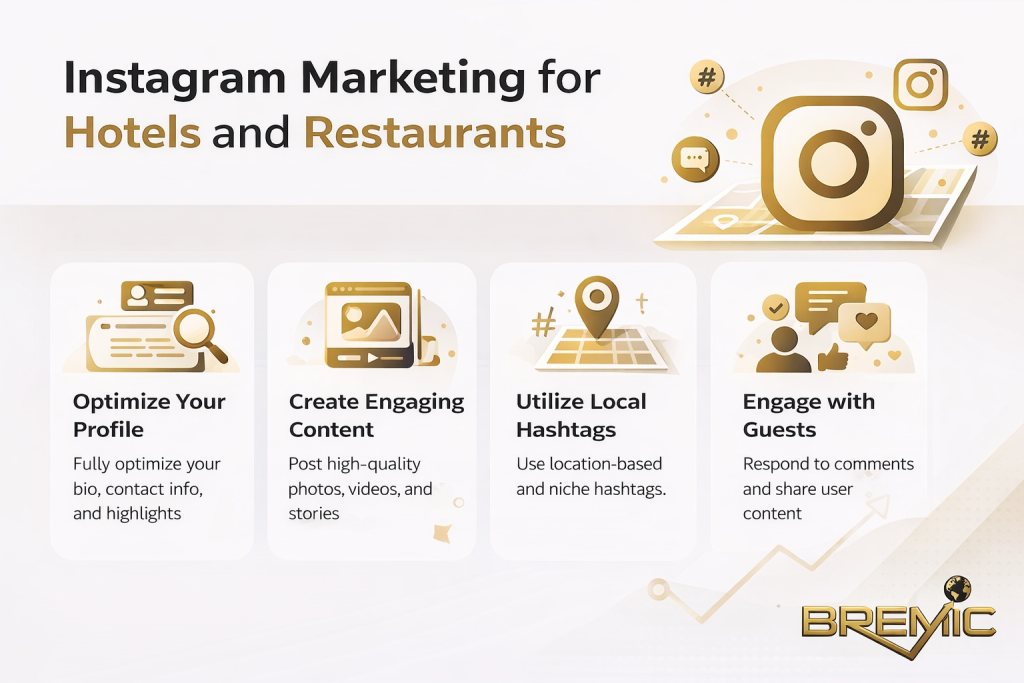
Optimize the profile like a landing page
Many businesses invest in content while neglecting the profile itself. That is a mistake. Your Instagram profile is often functioning like a micro landing page.
It should communicate, within seconds:
- what the business is
- who it serves
- what makes it distinct
- where it is located
- what action the visitor should take next
For hotels, that may mean emphasizing the type of stay experience and location. For restaurants, it may mean clarifying cuisine, service style, or reservation path. If the profile creates ambiguity, conversion drops.
Use formats based on audience behavior
Different formats do different jobs. Reels often support reach and discovery. Carousels are useful for storytelling and showcasing multiple angles of an experience. Stories help with frequency, immediacy, and audience nurturing. Highlights can answer recurring questions and reduce friction.
That does not mean every account needs every format in equal proportion. Social media marketing and optimization means using the right format for the right stage of the journey.
Important Subtopics
Content Strategy for Hotels
Hotel Instagram content works best when it sells the experience rather than just the room. A polished bed shot is rarely enough on its own. Potential guests want to understand what staying there feels like.
That usually means combining visual assets across several layers: property overview, room details, neighborhood context, lifestyle moments, guest experiences, and behind-the-scenes service quality. The goal is to reduce uncertainty and create emotional clarity.
A hotel with a strong brand identity should also maintain visual consistency. That includes tone, editing style, composition, and messaging. In hospitality, inconsistency can weaken premium perception.
Content Strategy for Restaurants
Restaurant content needs to do more than make food look good. It should help people understand what the dining experience is actually for. Is it casual and fast, refined and intimate, family-friendly, trend-driven, or event-oriented?
The most effective restaurant accounts usually balance dish-focused content with context. That includes chef perspective, kitchen energy, dining room atmosphere, seasonal changes, drink pairings, service moments, and customer reactions.
This helps the account move beyond food photography into brand positioning.
User-Generated Content and Social Proof
In hospitality, third-party validation is especially valuable. Guests and diners trust real customer content because it feels less curated. Reposting user-generated content, when done selectively and with permission, can strengthen credibility and show that the experience matches the marketing.
That said, quality control matters. Not every guest photo supports the brand. Optimization includes knowing which content strengthens trust and which weakens presentation.
Captions, Hashtags, and Local Relevance
Captions should support the visual rather than repeat it. A strong caption adds context, answers a question, highlights a benefit, or creates a clear next step. Weak captions tend to be vague, repetitive, or generic.
Hashtags are no longer a shortcut to growth by themselves. They can still help with context and niche discoverability, but they should support the post rather than carry it. Local relevance, strong creative, clear positioning, and engagement quality matter more.
For hotels and restaurants, geotags, local references, destination context, and collaborative visibility often provide more value than broad hashtag stuffing.
Common Mistakes
Posting attractive content without strategy
A visually appealing feed can still underperform if it does not address customer intent. Many hospitality accounts post beautiful content that never explains why someone should choose that property or venue.
Treating engagement as the main KPI
Likes and views can be useful indicators, but they are not business results. Hotels should care about inquiries, direct bookings, profile actions, website clicks, and branded search lift. Restaurants should look at reservations, walk-ins influenced by campaigns, menu interest, and repeat engagement from local audiences.
Ignoring consistency
Most accounts do not fail because of one bad post. They fail because their messaging, posting cadence, and value proposition are inconsistent. Social media marketing and optimization is cumulative. Momentum comes from repetition with direction.
Copying competitors too closely
Competitive research is useful. Copying is not. Hotels and restaurants that mimic what everyone else is doing usually become interchangeable. Distinct positioning matters more than trend imitation.
Practical Guidance
Start by auditing the current account honestly. Look at the profile, content themes, visual consistency, posting frequency, engagement quality, and conversion path. Then identify what the account is actually communicating to a first-time visitor.
From there, build a simple operating structure:
- define two to four core content pillars
- align each pillar with a business objective
- create a realistic publishing cadence
- track profile actions and business-related outcomes
- refine based on patterns, not isolated posts
For hotels, a workable structure might include property experience, local destination content, guest proof, and booking-focused offers. For restaurants, it may include signature dishes, dining atmosphere, team or kitchen storytelling, and occasion-based promotions.
This is also where internal content integration matters. Instagram should not operate in isolation. It should connect with the website, local SEO, review strategy, email marketing, and brand content. Businesses building a stronger digital presence should also connect this topic to related resources on local SEO, conversion-focused content, hospitality branding, and channel-specific content strategy.
Timing and Expectations
Instagram results are rarely immediate, especially for businesses that are rebuilding weak accounts or inconsistent strategies. Early improvements often appear in engagement quality, profile visits, and branded interest before they appear in direct revenue.
A realistic expectation is that meaningful progress comes from steady execution over several months. The timeline depends on content quality, competition, audience fit, brand strength, and operational consistency.
That is why short-term spikes should not be confused with strategic success. Sustainable performance comes from better positioning, clearer messaging, and stronger audience alignment.
Conclusion
Instagram marketing for hotels and restaurants works best when it is treated as a structured visibility and trust channel, not just a content feed. The businesses that perform well are usually the ones that understand what customers need to see before they feel ready to book, visit, or recommend.
Social Media Marketing & Optimization provides the framework for that work. It turns Instagram from a reactive posting habit into a strategic part of a wider digital presence. For hospitality brands, that means showing the experience clearly, reducing doubt, reinforcing brand relevance, and supporting real business outcomes over time.
The goal is not to publish more content for the sake of activity. It is to build a profile and content system that helps the right audience choose you with confidence.